What Is a Managed Care Organization and How Does It Affect Your Rights?
HMOs, PPOs, and EPOs are all managed care organizations, but they give you very different rights when it comes to appeals, referrals, and seeing specialists. Here is what actually changes based on your plan type.
Most health insurance plans in the United States are managed care organizations. That means they manage the cost and delivery of health care through contracts with providers and through coverage rules. The type of managed care plan you have determines who you can see, whether you need referrals, and what rights you have when something is denied.
The three main managed care structures
HMO (Health Maintenance Organization): You choose a primary care physician (PCP) who coordinates care and provides referrals to specialists. You generally cannot see out-of-network providers except in emergencies. Networks are often narrower and premiums may be lower. Referral rules add a step before specialist care, and that step is another place where authorization can be denied.
PPO (Preferred Provider Organization): There is usually no PCP requirement and no referrals for most services. You can see any provider but pay more for out-of-network care. Networks are often larger than HMO networks. You get more flexibility but often pay higher premiums.
EPO (Exclusive Provider Organization): Like an HMO, you must stay in network except in emergencies. Like a PPO, you often do not need referrals. It combines cost control with some scheduling flexibility.
HDHP (High-Deductible Health Plan): This describes deductible design and HSA eligibility, not network structure. An HDHP can be built as an HMO, PPO, or EPO.
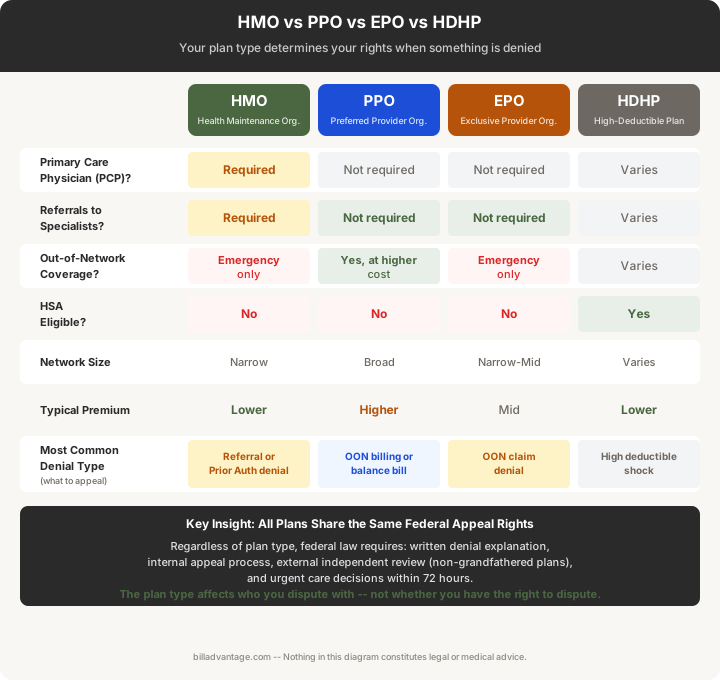
How your plan type affects your appeal rights
HMO members: Prior authorization denials are common because referrals add an approval step. When you are denied, you follow the plan's internal process. Fully insured HMOs are also regulated by state insurance departments for many issues. Employer HMOs that are ERISA-governed follow federal appeal rules. You may have independent medical review rights depending on plan type and state.
PPO members: Out-of-network denials or reduced allowed amounts are frequent pain points. The No Surprises Act addresses many surprise out-of-network bills at in-network facilities. Independent dispute resolution exists under federal law for qualifying situations.
Employer plan members (any network model): ERISA governs most private employer plans regardless of HMO, PPO, or EPO labeling. ERISA preempts many state laws, so state insurance commissioner complaints often do not apply the same way they do for individual marketplace coverage. Appeals follow the plan's internal process, then may move to external review and federal court remedies.
The National Association of Insurance Commissioners maintains a directory of all state insurance departments.
State commissioners regulate fully-insured plans. ERISA employer plans are regulated by the federal Department of Labor, not state commissioners.
Referral denials: an HMO-specific issue
If your PCP will not refer you or the plan denies a specialist visit, that is still a prior authorization style denial at the referral level. You have the same core appeal rights as other authorization denials. Ask your PCP to document medical necessity and file the internal appeal with that documentation attached.
What many managed care plans share
Regardless of plan type, federal law often requires:
- A written explanation of denials with a specific reason
- An internal appeal process
- External independent review for many non-grandfathered plans
- Urgent care decisions on short timelines
- Standard pre-service and post-service decision timelines for many situations
Exact timelines depend on whether the claim is urgent, pre-service, or post-service. Always read your notice.
211 connects people to local social services including emergency financial assistance, utility help, food programs, healthcare navigation, and insurance enrollment support. Free, confidential, available 24 hours a day.
Text your ZIP code to 898211 for two-way text support. Available in all 50 states, DC, and Puerto Rico (99% population coverage). Operated by United Way Worldwide. Free and confidential.
Ready to take action?
Denial Letter Translator helps you translate denial language into plain English.
Prior Authorization Appeal Generator helps you draft appeal scaffolding when authorization is the issue.
Bill Advantage is a document literacy tool. Nothing in this article constitutes legal or medical advice.
Guides and tools on Bill Advantage
Explore tools, glossary entries, and denial code pages that match this topic.
More Insurance Appeals guides
Aetna publishes the clinical criteria it uses to approve or deny claims. Here is how to find the relevant bulletin and use it in your appeal.
Read articleAnthem Blue Cross Denials: Why Your State Matters More Than You ThinkAnthem operates as independent Blue Cross Blue Shield plans by state. Your denial rights and appeal process depend on which state plan you have.
Read articleCO-15 Prior Authorization Denial: What to Do When Your Provider Did Not Get ApprovalCO-15 means prior authorization was missing or invalid. You may not owe this bill. Here is how to determine responsibility and appeal.
Read article