How to File a Complaint with Your State Insurance Commissioner
Your state insurance commissioner has real enforcement power over fully insured health plans, but not over most ERISA employer plans. Here is when a complaint works, when it does not, and how to file one that gets a serious response.
Every state has an insurance commissioner or department of insurance that regulates health insurance sold in that state. A complaint can be a powerful tool when your situation actually falls under state jurisdiction.
When a state insurance commissioner complaint works
State commissioners regulate fully insured health insurance products. Common examples include:
- Individual health plans purchased on or off the ACA marketplace
- Small group plans that are fully insured
- Medicare supplement (Medigap) policies sold in the state
- Many short-term health products where permitted
For these plan types, the commissioner can investigate, require the insurer to respond, and in serious cases pursue fines or corrective action.
The National Association of Insurance Commissioners maintains a directory of all state insurance departments.
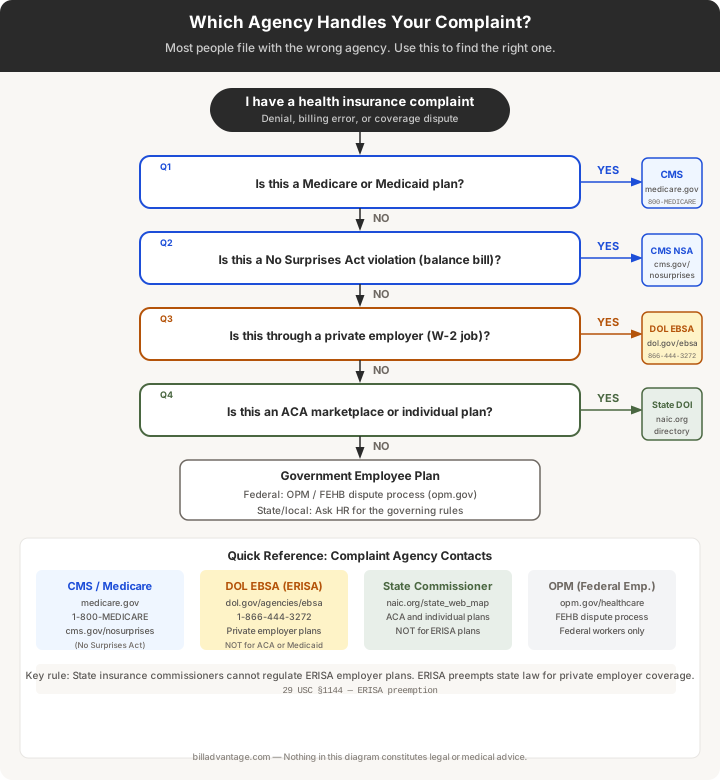
State commissioners regulate fully-insured plans. ERISA employer plans are regulated by the federal Department of Labor, not state commissioners.
When it does not work: ERISA employer plans
ERISA preempts most state insurance regulation for many employer-sponsored plans. If your coverage is through a private employer, the state commissioner often has no jurisdiction over the underlying plan. ERISA enforcement is primarily federal, through DOL EBSA and federal courts.
How to tell: If your employer is a private company (not a government agency), your plan is very likely ERISA-governed. Check the Summary Plan Description for ERISA language.
For ERISA plan issues, contact the U.S. Department of Labor Employee Benefits Security Administration (EBSA), not the state commissioner, for many benefit disputes.
The Employee Benefits Security Administration handles complaints about ERISA-governed employer health plans.
For private employer health plans only. Not for ACA marketplace, Medicare, or Medicaid plans.
How to file an effective complaint
-
Document everything first. Gather denial letters, EOBs, claim numbers, and a simple timeline of calls and emails.
-
Use the official intake channel. Most states offer an online complaint form. Search for your state name plus "department of insurance complaint" and use the government domain.
-
Be specific. Include dates, claim numbers, the exact denial reason quoted from the letter, and what you believe the insurer did wrong. Vague complaints get slower traction.
-
Match the legal name of the insurer to your ID card and the denial letter.
-
Request a written response from the regulator and keep a copy of your submission.
What happens after you file
Many offices forward the complaint to the insurer and require a written response within a defined window. Insurers often resolve issues faster once a regulator is copied. You should receive written correspondence from both the insurer and the regulator. If a violation is found, regulators can require corrective action.
When to also involve CMS
For Medicare Advantage and Part D issues, use Medicare.gov pathways in addition to, or instead of, the state commissioner, depending on the product.
For No Surprises Act violations, CMS maintains intake at https://www.cms.gov/nosurprises.
CMS enforces No Surprises Act protections for surprise billing and balance billing violations.
Ready to take action?
Denial Letter Translator helps you decode denial codes before you write the regulator.
Bill Advantage is a document literacy tool. Nothing in this article constitutes legal or medical advice.
Guides and tools on Bill Advantage
Explore tools, glossary entries, and denial code pages that match this topic.
More Insurance Appeals guides
Aetna publishes the clinical criteria it uses to approve or deny claims. Here is how to find the relevant bulletin and use it in your appeal.
Read articleAnthem Blue Cross Denials: Why Your State Matters More Than You ThinkAnthem operates as independent Blue Cross Blue Shield plans by state. Your denial rights and appeal process depend on which state plan you have.
Read articleCO-15 Prior Authorization Denial: What to Do When Your Provider Did Not Get ApprovalCO-15 means prior authorization was missing or invalid. You may not owe this bill. Here is how to determine responsibility and appeal.
Read article